


How Cannabis Pre-Rolls Are Manufactured at Scale
How Cannabis Pre-Rolls Are Manufactured at Scale
Key Takeaways
- The pre roll manufacturing process at scale requires precision equipment, consistent inputs, and quality control at every stage.
- The process moves from flower intake and grinding through filling, finishing, inspection, and retail-ready packaging.
- Infused pre-rolls — including those with live resin, liquid diamonds, or kief — require additional production steps and specialized equipment.
- Fill weight consistency is the most critical quality variable in pre-roll manufacturing. Small deviations at scale translate into significant product and compliance issues.
- Automation has transformed high-volume pre-roll production, but quality control and finishing still require experienced human oversight at every stage.
- Partnering with a licensed pre-roll manufacturing facility gives brands access to production systems built for consistency and scale without investing in equipment or staff internally.
Why Pre-Roll Manufacturing Is More Complex Than It Looks
Pre-rolls are one of the most popular product categories in the California cannabis market. They are also one of the most operationally demanding to produce at scale.
A single pre-roll looks simple. A cone, some ground flower, a twist at the top. But producing thousands of consistent, compliant, retail-ready pre-rolls every week requires a production system with precision at every step.
Fill weights need to be accurate and consistent. The grind needs to be uniform. Cones need to be filled without air pockets or structural failures. Infused products need additional inputs applied correctly and evenly. Finished pre-rolls need to pass visual inspection before they get sealed, labeled, and packed.
When any of these steps is off, the downstream effects compound. Inconsistent fill weights create compliance labeling problems. Irregular grind creates draw issues. Poorly finished pre-rolls create negative consumer experiences and retailer complaints that erode brand reputation.
This post walks through the full pre-roll manufacturing process at scale — from flower intake through retail-ready packaging — and explains what separates a production system that delivers consistent quality from one that does not.
Pre-Roll Formats and Product Types
Before production begins, the brand and manufacturing partner align on the product specifications. Pre-rolls come in a wide range of formats, and each has different production requirements.
Common Pre-Roll Formats
| Format | Description |
| Single Pre-Roll | One pre-roll per package — most common retail format |
| Multipack | Multiple pre-rolls per package — 2-packs, 5-packs, and 10-packs are common |
| Mini Pre-Rolls | Smaller format pre-rolls, often sold in larger count multipacks (5 or 10) |
| King Size | Larger format — typically 1.5g to 2g per unit |
| Infused Pre-Roll | Pre-roll with concentrate, kief, or other infused material added |
| Blunt | Tobacco leaf or hemp wrap instead of a paper cone |
Cone Types and Materials
The cone or wrap used in a pre-roll is a brand decision that affects both the consumer experience and the production workflow. Common options include:
- Standard paper cones — the most widely used format, compatible with most automated filling equipment
- Hemp paper cones — a popular premium option, similar production workflow to standard paper
- Rice paper cones — thinner and slower burning, used in premium product lines
- Unbleached cones — preferred by health-conscious consumers, same production workflow
- Tobacco leaf wraps (blunts) — require different filling and sealing equipment
- Hemp leaf wraps — growing in popularity, typically filled similarly to blunts
Cone format selection is finalized before production begins because it directly affects which equipment and filling methods will be used.
Step 1: Flower Intake and Input Preparation
Pre-roll manufacturing begins with the flower. The quality and consistency of the input material directly affects the quality and consistency of the finished product.
Flower Intake and Inspection
When bulk flower arrives at the manufacturing facility, it goes through an intake process that includes:
- Weight verification against the accompanying Metrc transfer documentation
- Visual inspection for quality, moisture content, and absence of foreign material
- Moisture content measurement — flower that is too wet or too dry will not grind or fill correctly
- Entry into the facility’s Metrc system to maintain track-and-trace compliance
Flower that does not meet quality specifications should be flagged at intake rather than passed to production. Catching input quality issues early prevents compounding problems downstream.
Moisture Management
Moisture content is one of the most important variables in pre-roll production. Flower that is too moist clogs grinders, produces inconsistent fill weights, and creates products that burn poorly. Flower that is too dry grinds to powder, fills inconsistently, and produces harsh consumer experiences.
Most pre-roll production targets a moisture content range of approximately 10% to 14%. If incoming flower falls outside this range, it may need to be conditioned before grinding — either dried further or rehydrated — to reach the target range.
Step 2: Grinding
Grinding is the step that converts whole flower into the uniform particle size needed for consistent, high-volume filling. It is one of the most important variables in pre-roll quality and one of the most frequently underestimated.
Why Grind Consistency Matters
The grind determines how the flower flows through filling equipment, how evenly it packs into cones, and ultimately how the finished pre-roll burns.
A grind that is too coarse produces air pockets in the pre-roll, inconsistent fill weights, and structural weakness. A grind that is too fine — essentially powder — creates airflow restriction, harsh smoke, and filling equipment clogging.
Experienced manufacturing teams dial in grind settings for each flower input and run sample fills before beginning a full production run.
Grinding Equipment at Scale
Small-batch hand grinding is not viable at commercial scale. High-volume pre-roll manufacturers use industrial grinders capable of processing large quantities of flower quickly and consistently.
Common industrial grinding options include:
- Drum grinders — high throughput, consistent particle size, widely used for large runs
- Blade grinders — faster but less consistent particle size than drum grinding
- Multi-stage grinding systems — pass flower through multiple grinding stages to achieve more uniform particle size
After grinding, the material may be sifted to remove oversized particles or stems before moving to the filling stage.
Step 3: Cone Filling
Cone filling is the core production step — the point where ground flower is loaded into cones to create finished pre-rolls. It is also where fill weight consistency is won or lost.
Manual vs. Automated Filling
Pre-roll filling can be done manually, semi-automatically, or with fully automated equipment. The right approach depends on production volume, product format, and the quality standards the brand requires.
| Method | How It Works | Throughput |
| Manual Filling | Hand-filling individual cones | Very low — not viable for commercial scale |
| Semi-Automated (Knock Box) | Cones loaded into a tray, flower packed by tamping | Low to medium — dozens to low hundreds per run |
| Automated Pre-Roll Machine | Cones loaded, filled, and tamped mechanically | High — hundreds to thousands per hour depending on machine |
Pre-Roll Filling Machines
Automated pre-roll machines are the backbone of high-volume commercial production. These machines load cones into a filling chamber, distribute ground flower evenly, vibrate or tamp the flower to achieve consistent packing density, and eject finished pre-rolls for finishing.
Well-known automated pre-roll machine platforms used in commercial production include cone-filling systems from companies like RollPros, STM Canna, and others. Each has different throughput capacities, cone size compatibility, and maintenance requirements.
At a properly run commercial facility, automated pre-roll equipment can produce hundreds to several thousand finished pre-rolls per hour depending on the machine model and cone format.
Fill Weight Targets and Tolerances
Before a production run begins, fill weight targets and acceptable tolerances are established. These are the specifications the finished pre-rolls must meet to pass quality control.
California requires that the net weight declared on the label is accurate. For a pre-roll labeled at 1 gram, the actual fill weight must be 1 gram within an acceptable tolerance.
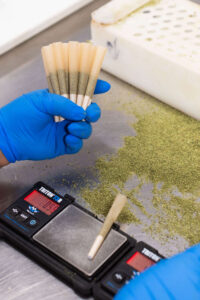
Manufacturing teams monitor fill weights throughout the production run using calibrated scales, pulling samples at regular intervals to verify that the machine is maintaining target weights. Drift in fill weight is caught and corrected before it creates compliance or quality issues across the full batch.
| Need Pre-Rolls Manufactured at Scale?
At Chronic USA®, we produce pre-rolls at commercial volume with consistent fill weights, quality inspection at every stage, and compliance packaging built into the workflow. |
Step 4: Infused Pre-Roll Production
Infused pre-rolls are one of the fastest-growing segments of the pre-roll market. They command premium price points and have become a significant part of the product mix at many California dispensaries.
Manufacturing infused pre-rolls requires additional production steps beyond standard filling and introduces more variables that need to be managed for quality and compliance.
What Are Infused Pre-Rolls?
Infused pre-rolls are cannabis pre-rolls that have had additional concentrate, oil, or cannabis-derived material added to increase potency or enhance the consumer experience. Common infused formats include:
| Infused Type | How It Is Applied |
| Live Resin Infused | Live resin applied to the interior of the pre-roll, exterior, or both |
| Liquid Diamonds Infused | THCA diamonds suspended in terpene-rich sauce applied to the product |
| Distillate Infused | Cannabis distillate applied to the interior or used to coat the exterior |
| Kief Coated | Ground cannabis trichomes (kief) applied to the exterior of the pre-roll |
| Hash Infused | Bubble hash or dry sift hash incorporated into the fill material or rolled on the exterior |
| Live Rosin Infused | Solventless live rosin applied to the interior or exterior |
| Caviar / Moon Rock Pre-Roll | Pre-roll coated in oil and then rolled in kief — a combination infusion method |
The Infused Pre-Roll Production Process
Standard pre-rolls are filled, finished, and packaged. Infused pre-rolls require additional steps between filling and finishing, depending on the infusion type.
Interior Infusion (Oil or Concentrate in the Fill)
Some infused formats involve coating the interior of the cone before filling, or blending concentrate into the ground flower before the fill step.
- The cone interior is coated with distillate or oil before loading into the filling machine, or
- Concentrate is blended directly into the ground flower at a specific ratio before filling begins
- The infused material must be distributed evenly to ensure consistent potency throughout the pre-roll
Exterior Infusion (Oil Coating and Kief Rolling)
The most visually distinctive infused format involves coating the outside of the pre-roll with oil and then rolling it in kief, hash, or other material.
- Finished pre-rolls are coated in a layer of cannabis oil or distillate
- The oil-coated pre-roll is rolled in kief, sugar, or hash
- The coated pre-roll is allowed to set before packaging
Exterior infusion is more labor-intensive than interior infusion and requires careful handling to avoid damaging the finished product before packaging.
Cannabinoid Content Tracking for Infused Pre-Rolls
Infused pre-rolls have higher and more complex cannabinoid content than standard pre-rolls. The total THC content on the label must reflect the combined cannabinoid content of both the flower and the infused material.
This requires accurate documentation of the cannabinoid content of both inputs and precise measurement of the infused material added per unit. The label declaration must match the COA for the finished product, not just the flower component.
Step 5: Finishing and Quality Inspection
Once pre-rolls are filled — and infused, where applicable — they go through a finishing and inspection process before packaging.
Twist Finishing
Most pre-rolls use a twisted tip to close the open end of the cone after filling. This finishing step is done manually or with semi-automated finishing tools.
The twist must be tight enough to keep the fill material in place during handling and packaging, but not so tight that it tears the cone material or deforms the pre-roll.
At high production volumes, twist finishing is one of the more labor-intensive steps in the process. Some facilities use semi-automated twist finishing equipment to increase throughput while maintaining consistency.
Visual Quality Inspection
Before pre-rolls move to packaging, they go through a visual quality inspection. Inspectors look for:
- Structural defects — tears, holes, or weak points in the cone material
- Fill consistency — pre-rolls that appear significantly underfilled or overfilled
- Finish quality — loose or poorly formed twist tips
- Foreign material — any visible contamination in or on the product
- Infusion quality (for infused products) — even coating, no bare spots or pooling
Pre-rolls that fail visual inspection are pulled from the production run before packaging. Catching defects at this stage is significantly less costly than discovering them after products are sealed and labeled.
Weight Verification
A sample of finished pre-rolls from each production run is weighed on calibrated scales to verify that fill weights are within the established tolerance for that SKU.
If weights have drifted outside tolerance, the run is paused and equipment calibration is checked before production continues. Units outside tolerance are not packaged for retail.
Step 6: Retail Packaging and Compliance Labeling
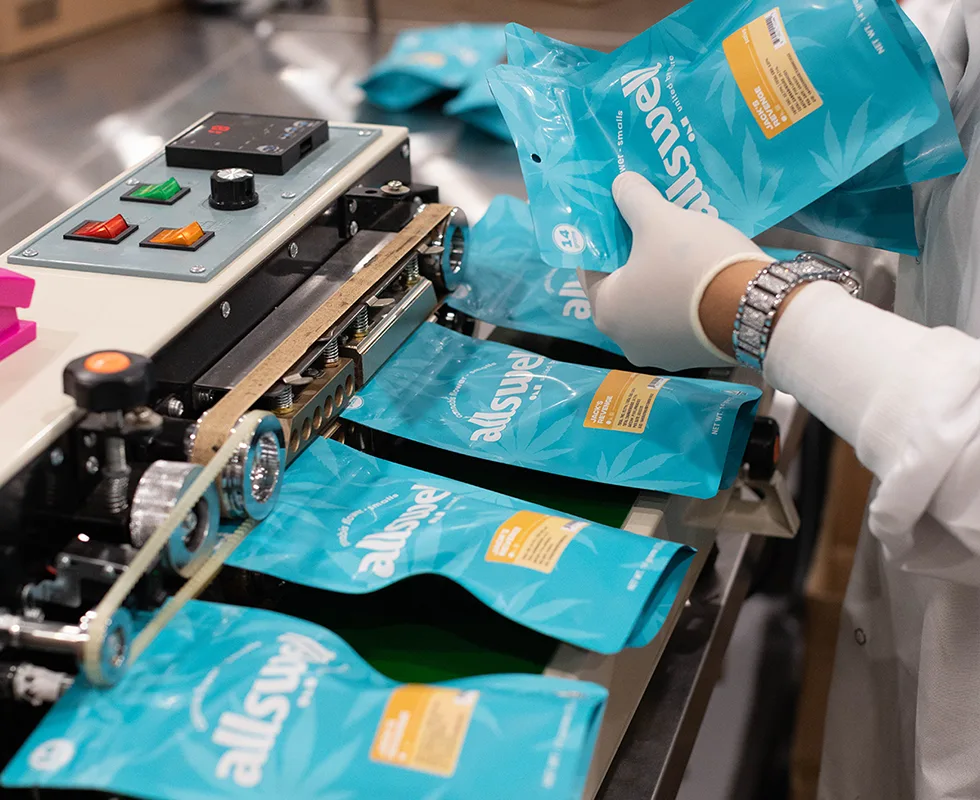
Finished, inspected pre-rolls move to the packaging station. This is where individual pre-rolls or multipacks are placed into retail packaging, compliance labels are applied, and products are prepared for distribution.
Packaging Formats for Pre-Rolls
| Packaging Format | Typical Application |
| Child-Resistant Tube | Single pre-rolls — one of the most common retail formats |
| Child-Resistant Box | Singles and multipacks — premium presentation format |
| Child-Resistant Mylar Pouch | Multipacks — flexible, cost-effective for higher count packs |
| Glass or Plastic Jar | Used for mini pre-roll multipacks |
| Blister Pack with CR Backing | Used for some single and multipack formats |
California Compliance Labeling for Pre-Rolls
Every pre-roll package must carry a California DCC-compliant label that includes:
- Universal cannabis symbol on both the primary and informational panels
- Full government warning statement
- Total THC per pre-roll and per package (for multipacks), in milligrams
- Total CBD per pre-roll and per package
- Net weight of cannabis in both grams and ounces
- Batch and lot number tied to the production run
- Manufacturer name and license number
- Distributor name and license number
- Manufactured date
- Facility address
- Metrc UID tracking number
For infused pre-rolls, the label must reflect the combined cannabinoid content of the flower and all infused materials. The label cannabinoid declarations must match the COA for the finished product batch.
Tamper Sealing
Once packaged and labeled, pre-rolls are tamper-sealed before leaving the production floor. Tamper-evident seals are required on all California cannabis retail products.
Common tamper seal formats for pre-rolls include heat shrink bands over tube caps, tamper-evident sticker seals over box openings, and sealed pouch formats with tear notches.
Case Packing and Distribution Preparation
Finished, labeled, and tamper-sealed pre-rolls are counted, case-packed, and prepared for transfer to the licensed distributor. Metrc records are updated to reflect the completed production batch and the outgoing transfer.
Quality Control in High-Volume Pre-Roll Manufacturing
Quality control in pre-roll manufacturing is not a single checkpoint at the end of the line. At scale, quality control is continuous — built into every stage of production rather than applied only at the end.
QC Checkpoints Across the Production Process
| Production Stage | QC Activity |
| Flower Intake | Moisture content, visual quality, weight verification |
| Pre-Grind | Moisture adjustment if needed, stem and foreign material removal |
| Post-Grind | Particle size consistency check, sift for oversized material |
| During Filling | Regular fill weight sampling at set intervals throughout the run |
| Post-Fill Inspection | Visual inspection for structural defects and fill consistency |
| Post-Infusion | Coating evenness and infusion weight verification (infused products) |
| Pre-Packaging | Final weight verification on sample units from the batch |
| Post-Packaging | Label accuracy review, tamper seal confirmation, case count verification |
The Fill Weight Problem at Scale
Fill weight consistency is the most operationally significant quality challenge in high-volume pre-roll manufacturing. Here is why it matters at scale.
A fill weight deviation of 0.05 grams per unit sounds minor. Across a production run of 10,000 units, that deviation represents 500 grams of flower — either overfilled (reducing margin and creating labeling inaccuracies) or underfilled (creating compliance violations and consumer complaints).
Experienced pre-roll manufacturing facilities have established calibration protocols, regular sampling schedules, and clear escalation procedures when fill weight drift is detected mid-run. These systems prevent small deviations from becoming large-scale problems before they are caught.
Documentation and Batch Records
Every production run generates batch records that document:
- Flower inputs used — strain, batch numbers, weights
- Infused material inputs — type, batch numbers, weights applied per unit
- Grind settings and equipment used
- Fill weight samples and results throughout the run
- Quality inspection results
- Final unit count and case pack totals
- Metrc batch and transfer records
These records are essential for COA matching, Metrc compliance, and for resolving any quality or compliance questions that arise after products reach distribution.
Why Brands Outsource Pre-Roll Manufacturing
Building an internal pre-roll manufacturing operation is a significant undertaking. The equipment investment alone — industrial grinders, automated filling machines, finishing tools, packaging equipment — runs into the hundreds of thousands of dollars before staff, facility, and compliance infrastructure are added.
For most cannabis brands, outsourcing pre-roll manufacturing to a licensed facility is the more efficient path to consistent, scalable production.
| Advantage | What It Means for Your Brand |
| No Equipment Investment | Access to industrial grinders, filling machines, and packaging equipment without purchasing |
| No Production Staff | No hiring, training, or managing production workers |
| Established QC Workflows | Built-in fill weight monitoring, inspection, and batch documentation |
| Compliance Built In | California DCC-compliant labeling and packaging as part of the production workflow |
| Faster Time to Market | Production can begin in weeks, not months |
| Scalable Volume | Increase or decrease production runs without fixed capacity constraints |
| Infused Capabilities | Access to infusion workflows without building specialized production lines |
| Ready to Scale Pre-Roll Production Without Building a Factory?
Chronic USA® produces pre-rolls at commercial volume in Long Beach, California. Singles, multipacks, infused formats — built to your specs with quality control and compliance at every step. |
Frequently Asked Questions
How are cannabis pre-rolls manufactured at scale?
Large-scale pre-roll manufacturing involves a multi-step process: flower intake and inspection, moisture management, grinding to a uniform particle size, automated cone filling to target fill weights, finishing (twist or seal), visual quality inspection, compliance labeling, tamper sealing, and case packing for distribution. Automated filling machines are the core of high-volume production, capable of producing hundreds to thousands of pre-rolls per hour depending on the equipment and format.
What are infused pre-rolls and how are they made?
Infused pre-rolls are cannabis pre-rolls that have had additional concentrate, oil, or cannabis-derived material added to increase potency or enhance the consumer experience. Common infused formats include live resin infused, liquid diamonds infused, distillate infused, kief coated, hash infused, and live rosin infused. Production involves either blending concentrate into the fill material before filling, coating the cone interior before filling, or coating the exterior of the finished pre-roll in oil and rolling it in kief or hash. Infused pre-rolls require additional production steps, specialized equipment, and more complex cannabinoid content documentation for labeling.
What equipment is used in pre-roll manufacturing?
Commercial pre-roll manufacturing uses industrial drum grinders or multi-stage grinding systems to produce uniform particle size, automated cone-filling machines to fill and tamp cones at high volume, calibrated scales for fill weight monitoring throughout production, semi-automated or manual twist finishing tools, labeling equipment for compliance label application, heat shrink or other tamper-sealing equipment, and case-packing stations for distribution preparation. Infused pre-roll production adds infusion application equipment and coating systems to the workflow.
Why is fill weight consistency so important in pre-roll manufacturing?
Fill weight consistency is critical for two reasons: compliance and quality. California requires that the net weight declared on the label is accurate. Pre-rolls that are consistently underfilled or overfilled create labeling compliance issues. At production scale, even a small deviation per unit compounds across thousands of units, representing significant product and cost implications. Fill weight inconsistency also affects consumer experience — underfilled pre-rolls burn too quickly, overfilled pre-rolls draw poorly and may be structurally weak.
What quality control steps are involved in pre-roll production?
Quality control in pre-roll manufacturing is continuous rather than a single end-of-line checkpoint. Key QC activities include moisture content verification at intake, particle size consistency checks after grinding, regular fill weight sampling throughout the production run, visual inspection of finished pre-rolls for structural defects and fill consistency, infusion quality checks for infused products, final weight verification before packaging, label accuracy review, and tamper seal confirmation before case packing.
What packaging is used for cannabis pre-rolls in California?
California requires all cannabis pre-rolls to be sold in child-resistant packaging. Common formats include child-resistant tubes (most common for singles), child-resistant boxes (singles and multipacks), child-resistant mylar pouches (multipacks), glass or plastic jars (mini pre-roll multipacks), and blister packs with CR backing. All packaging must also include a tamper-evident seal. Labels must include all DCC-required elements including the universal cannabis symbol, government warning, cannabinoid content, batch number, and Metrc UID.
How does moisture content affect pre-roll production?
Moisture content is one of the most important input variables in pre-roll manufacturing. Flower that is too moist clogs grinding equipment, produces inconsistent fill weights, and results in products that burn poorly. Flower that is too dry grinds to a fine powder, fills inconsistently, and produces a harsh consumer experience. Most pre-roll production targets a moisture content range of approximately 10% to 14%. Flower outside this range may need to be conditioned before production begins.
Can cannabis brands outsource pre-roll manufacturing in California?
Yes. Many California cannabis brands outsource pre-roll manufacturing to licensed facilities rather than building internal production capabilities. Outsourcing provides access to industrial filling equipment, established QC workflows, compliance-ready packaging and labeling, and experienced production teams without the capital investment in equipment, facility space, and production staff. It also allows brands to scale production volume up or down without fixed capacity constraints.
What is the difference between standard and infused pre-roll manufacturing?
Standard pre-roll manufacturing involves grinding flower, filling cones to a target weight, finishing, and packaging. Infused pre-roll manufacturing adds one or more steps depending on the infusion type: blending concentrate into the fill material, coating cone interiors before filling, or coating the exterior of finished pre-rolls in oil and rolling in kief or hash. Infused production is more labor-intensive, requires additional equipment for infusion application, and involves more complex cannabinoid content tracking because the label must reflect the combined potency of both the flower and all infused materials.
How long does it take to manufacture pre-rolls at commercial scale?
Production timelines depend on order volume, product format, and the manufacturing facility’s scheduling. At a well-equipped commercial facility, automated filling machines can produce hundreds to several thousand pre-rolls per hour. For most standard pre-roll orders, the production timeline from input intake to finished, packaged product ready for distributor pickup is typically a matter of days to one to two weeks depending on batch size and complexity. Infused pre-rolls and custom formats may require additional production time.